
-
June 22, 2026
- |
- |
-
Categories: Blogs

For years, the channel has talked about strategic selling, managed services, specialization, and ecosystems. AI is turning those ideas into the foundations of future partner success.
By Larry Walsh
Vendors and partners that Channelnomics speaks with often express two seemingly contradictory sentiments in the same breath: excitement about the future coupled with an equal measure of anxiety about how emerging trends will affect their value propositions and businesses.
The technology industry and, by extension, the channel are in a constant state of change. Every new technology introduces a new go-to-market strategy and revenue model. Each advancement either increases demand for the expertise of solution providers or introduces automation that diminishes the value of delivering products and services. These opposing forces serve as the engine of innovation and evolution.
Today, the technology industry and channel are undergoing profound change, largely driven by the rapid advancement of artificial intelligence and the automation that accompanies it. Many routine processes performed by channel partners will give way to automation. At the same time, the complexity of identifying, procuring, deploying, securing, and maintaining these systems will create new opportunities for partners to support customers.
The common thread connecting these changes is a shift from technology-centric selling to outcome-centric engagement. Customers increasingly care less about the products they buy and more about the business results they achieve. Growth, efficiency, resilience, and risk reduction are becoming the primary measures of technology value. The partners that thrive will be those that can connect technology investments directly to those business outcomes.
Through its interactions with hundreds of vendors and solution providers, Channelnomics has identified six roles that will define successful channel partners over the next five years. These will reshape how channel programs operate and how solution providers deliver value to both vendors and customers.
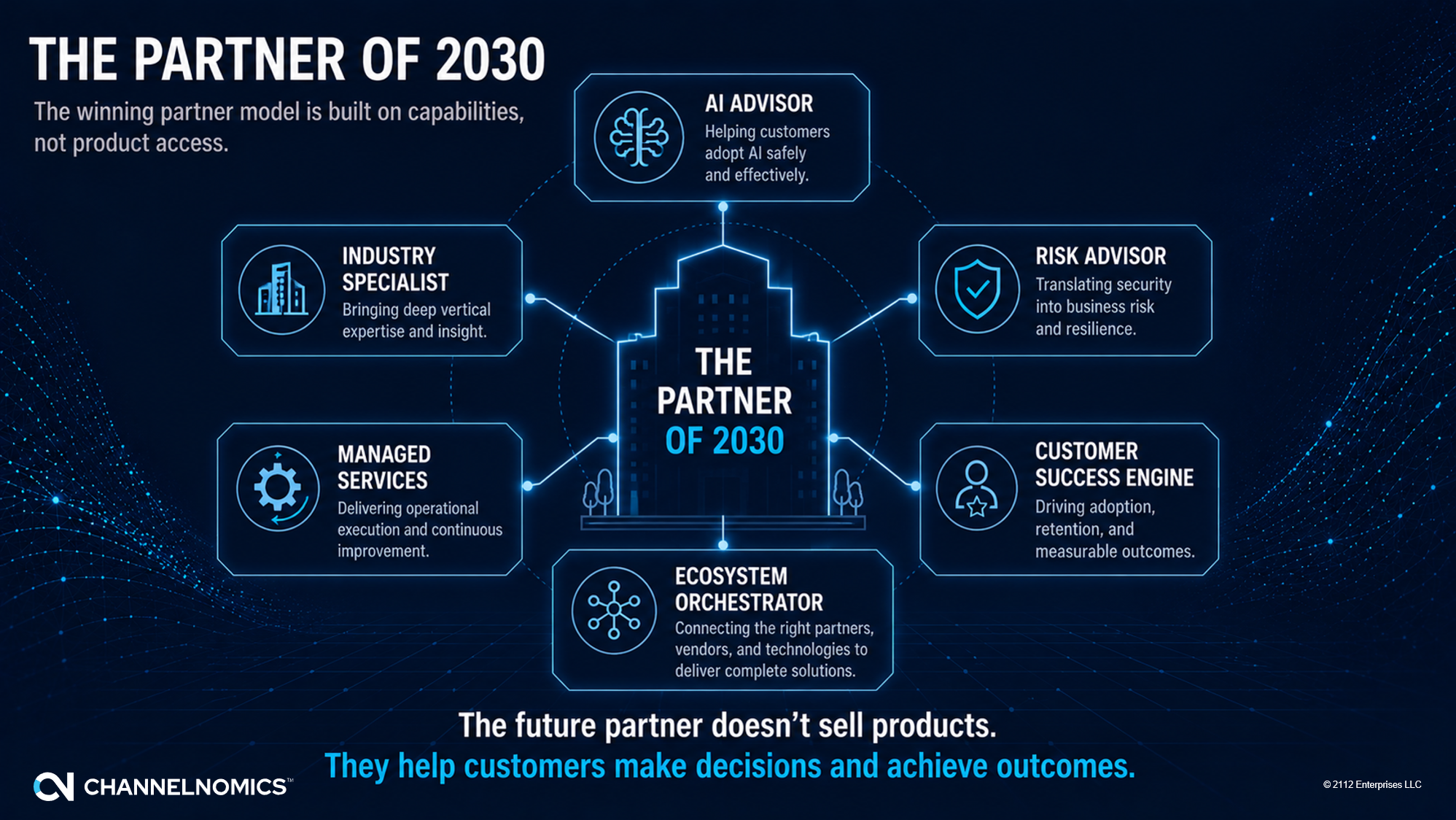
1. Artificial Intelligence Advisor
AI is a powerful tool with the potential to optimize business operations, unlock greater value from structured and unstructured data, accelerate revenue growth, and reduce operating costs. The challenge for most organizations is knowing how to apply AI effectively. Solution providers are already evolving into AI advisors, helping customers determine which business processes and workloads should be prioritized and how to implement systems that capitalize on AI-driven automation. This advisory role will become a core value proposition for next-generation solution providers.
The AI advisor role extends beyond selecting tools and automating processes. Organizations are increasingly concerned with how AI accesses, uses, and protects data. Solution providers will play a critical role in helping customers establish the governance, controls, and policies necessary to ensure that AI initiatives are both effective and trustworthy.
2. Risk Advisor
Cybersecurity will undergo significant change under the influence of AI and, eventually, quantum computing. Organizations will face greater risks to their data, systems, and operations than ever before. What remains unchanged are the foundational principles of security: confidentiality, integrity, and availability. Solution providers will move beyond selling and supporting security technologies to providing strategic guidance that helps customers understand risk exposure, strengthen resilience, and reduce the likelihood of compromise.
Data governance and digital sovereignty will become increasingly important elements of risk management. Customers need assurance that their information is secure, properly managed, and compliant with regulatory requirements. As a result, risk advisory services will extend beyond cybersecurity to include broader guidance on data stewardship, compliance, and operational resilience.
3. Industry Specialist
Meaningful AI adoption requires a deep understanding of business processes, operational requirements, and risk tolerances. These factors vary widely across industries. Generalists may possess strong technical capabilities, but specialists with deep vertical expertise will be better positioned to provide solutions tailored to the unique challenges of specific industries. Their knowledge, experience, and established best practices will become a significant competitive advantage.
4. Ecosystem Orchestrator
Just as customers need specialists who understand their operational requirements, they also need access to a broader network of suppliers, service providers, and experts. Successful solution providers will focus on their core strengths while partnering with vendors and peers to address capability gaps and extend their value propositions. No single company can meet every customer need. Delivering comprehensive solutions increasingly requires collaboration, coordination, and ecosystem engagement.
In many cases, a partner's ability to coordinate expertise across an ecosystem will become more valuable than any single product or service it delivers.
5. Next-Generation MSP
Talent shortages and rising labor costs will make hiring and retaining IT professionals increasingly difficult for many organizations. Businesses will continue to employ leaders who can drive strategic value, while relying on managed service providers to perform recurring operational tasks and augment internal expertise. The next generation of managed services will be less about recurring revenue and more about solving business problems, driving outcomes, and providing strategic guidance.
6. Customer Success Facilitator
Ultimately, the role of a solution provider is to bridge the gap between vendors and customers, ensuring operational and experiential success. Customers will increasingly evaluate solution providers based on the totality of the experience they deliver, from the first sales conversation through onboarding, adoption, optimization, renewal, and expansion. Demonstrating cost savings alone will no longer be sufficient. Customers want technology investments that help them grow, compete, and innovate. Solution providers will become the primary drivers of that experience-based value.
If these evolutionary trends sound familiar, they should. Vendors and channel advocates have discussed strategic selling, ecosystem engagement, co-selling, managed services, vertical specialization, and trust for decades. The difference is that these concepts were often treated as aspirations rather than requirements. In the age of AI and rapid technological change, they’re evolving from desirable characteristics into business imperatives.
Perhaps the most significant implication is that the era of the generalist solution provider is drawing to a close. The pace of innovation, the growing complexity of customer environments, and the demand for measurable business outcomes make it increasingly difficult for any organization to excel at everything. The partners that succeed will be those that understand where they create unique value, develop deep expertise in those areas, and leverage ecosystems to extend their capabilities.
The next generation of channel leaders will be defined not by the technologies they sell but by the outcomes they help customers achieve.
**************************************************************************************
Larry Walsh is the CEO, chief analyst, and founder of Channelnomics. He’s an expert on the development and execution of channel programs, disruptive sales models, and growth strategies for companies worldwide.

The sticking point isn’t product quality or partnership appeal; it’s about economics, so tying a ...

The Channelnomics 3Cs — capabilities, competency, and capacity — tell vendors whether a partner can ...

Research shows that working with distributors increases chances of go-to-market success for both ...




