
-
August 31, 2026
- |
- |
-
Categories: Blogs

The Channelnomics 3Cs — capabilities, competency, and capacity — tell vendors whether a partner can invest and grow. A fourth C, confidence, reveals whether it will.
By Larry Walsh
In the early days of Channelnomics, we developed a simple framework for evaluating and assessing a partner's potential for excelling with a vendor. We called it our "3Cs," a means of quickly identifying whether a partner is a good fit for your ecosystem.
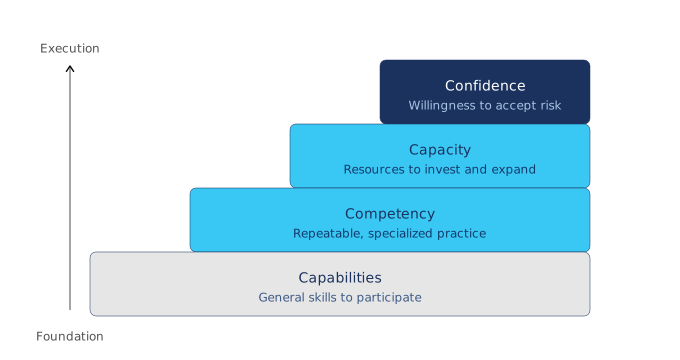
The 3Cs was a progressive framework that spanned foundation to execution.
- Capabilities: Every person and company can do something. If they couldn't, they wouldn't be employed or in business. Capabilities reflect the general skills required to work with a vendor and its products. This level is where generalists are often found.
- Competency: The channel is full of specialists — companies with specific practices around a technology (security, networking, artificial intelligence) or vertical (healthcare, financial services, manufacturing). Competency is about having a repeatable practice, something endemic to the brand and value proposition that sets a company apart from generalists.
- Capacity: This is the tricky one. Capacity is about having the organizational and financial resources to invest and succeed with a new vendor, technology, customer segment, or market — that is, to expand to address new opportunities.
Channelnomics developed this framework because we saw too many vendors rushing to sign up partners without giving due consideration to their abilities. The company that actually inspired the 3Cs was launching a new channel program for a managed service platform. It was so eager to start generating revenue that it ran out and signed up hundreds of partners without giving them a good look. Before long, the vendor had a broad managed-service network without productivity. Few of the partners that were signed up reached above the capabilities level; they needed partners with more competency and the capacity to expand.
Over the years, Channelnomics has used the 3Cs to help guide vendors on the development and optimization of their partner networks and ecosystems. It’s not the most exacting framework, and it’s not supposed to be. Channelnomics has other tools for assessing and evaluating partner applicability relative to their vendors.
The 3Cs are still applicable, but not entirely sufficient for the contemporary channel. Partners are facing economic and innovation pressures as never before. The pace of change is so fast that many partners are struggling to keep up with new technologies and market opportunities. Vendors often complain that partners aren't investing in their future, when in reality, they're still reaping the benefits of prior major investments. There's an imbalance in the go-to-market equation that often puts partners at a disadvantage.
This is why Channelnomics revised its framework to include a fourth C: confidence.
Every quarter, Channelnomics tracks partner economic sentiment in North America and Europe through our Partner Confidence Index (PCI). Now in its third year, PCI started as a means of tracking how well partners will perform, providing vendors and channel practitioners with directional indicators for what to expect from their partners in the field.
Through PCI and other research, Channelnomics learned how important confidence — or the acceptance of risk — is to partners. Whenever a vendor asks a partner to adopt a new product, take on a new service, venture into a new market, or accelerate sales, it’s asking for an investment. Investments equal risk, and partners are very much attuned to the consequences of negative risks.
Confidence is how partners demonstrate their ability to overcome challenges and accept risk. Confidence is the medium by which partners express their willingness to take on new challenges and apply their capacity to grow with and around a vendor.
Confidence, however, isn’t one-sided or free of vendor influence. A vendor can bolster partner confidence by providing better risk-reward equations. In practice, this means spelling out the economic equation by which partners will reap a return on investment (ROI). This ROI is a combination of the endemic rewards from the product sale (margin, rebates, resources that defray costs) and attached sales (managed services, professional services, complementary product sales). If the customer consideration and market demand for the total economic package exceed the cost, a partner with capacity will have higher confidence to accept the risk and invest in the new venture.
Again, the 4Cs framework of today doesn’t give vendors permission to avoid profiling partners and determining their probable interests. Rather, it's a starting point by which vendors and channel practitioners can discern which partners to approach and how to begin gauging their interest in participating and contributing to the channel ecosystem.
*********************************************************************************
Larry Walsh is the CEO, chief analyst, and founder of Channelnomics. He’s an expert on the development and execution of channel programs, disruptive sales models, and growth strategies for companies worldwide.

Vendors can profile the perfect partner and still get nothing in return. The difference comes down ...

Tech spending is up double digits while a third of partners lose money. Vendors are building their ...

Channel leaders keep addressing doubt with more data, but data isn’t the problem. Make the bet in ...




