Facilitated by Channelnomics, the Finance Forum brought vendor and distributor finance leaders together to challenge the “distribution tax” narrative and examine the measurable returns of the two-tier model.
Distribution remains one of the most durable – and often misunderstood – components of the technology go-to-market channel.
Few channel leaders question distribution’s role. Outside the channel, however, skepticism persists. Distribution is often viewed as a “tax” – a margin layer that reduces profitability rather than expands opportunity. Discounts, incentives, and program fees are scrutinized in isolation. The connection between distribution investment and return on channel investment (ROCI) is frequently obscured.
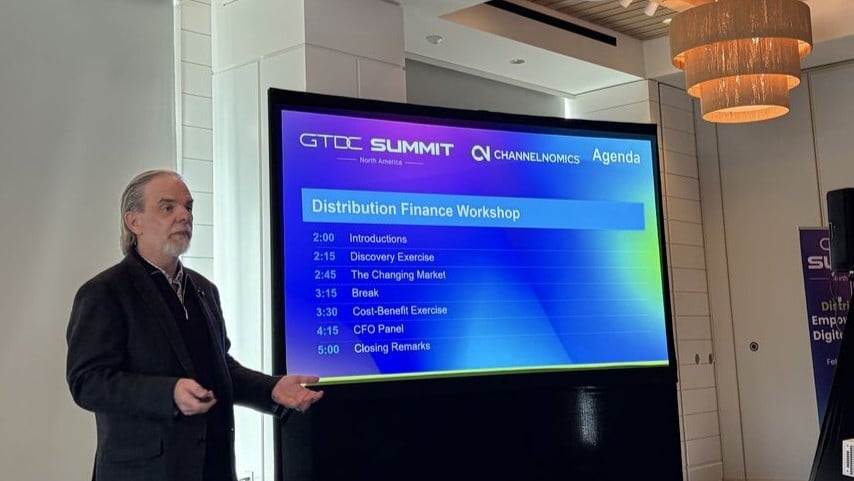
The disconnect between function and value framed the third annual Finance Forum, facilitated by Channelnomics at the Global Technology Distribution Council (GTDC) North America Summit in Oceanside, California, last week. The session brought together channel leaders, vendor executives, and a panel of senior distribution finance executives, including Robert Abramitis, CFO North America at TD SYNNEX; Michelle Angel, CFO North America at Exclusive Networks; Guy Stanley, Head of Finance at Arrow Electronics; and Alex Sun, VP of Finance at Ingram Micro, to examine the economics, mechanics, and value creation of the two-tier model.
The objective was clear: Move the conversation about distribution from perception to probability, from cost to return. The discussions and exercises produced several points worth sharing with the broader channel community.
The 'Distribution Tax'
One theme surfaced immediately: Distribution is often perceived internally by vendors as a margin drag rather than a value engine.
Finance leaders within vendor organizations frequently compare distribution margins with the apparent cost of expanding direct sales. In doing so, they overlook cost deferral and risk transfer. Distributors absorb credit exposure, inventory risk, bad debt, compliance management, logistics, and operational overhead that would otherwise sit on a vendor’s balance sheet.
When those factors are stripped out of the model, the two-tier structure appears expensive, but when they're properly included, the economics often invert.
The forum participants’ discussion reinforced a recurring problem: Vendors lack defensible, standardized cost-benefit models that translate distribution services into financial language understood by CFOs and boards. Distribution investments are too often evaluated narrowly within the channel budget instead of against enterprise-wide cost avoidance and operational efficiency.
Channel Conflict & Compensation Misalignment
No channel finance discussion is complete without addressing internal friction. Direct-sales organizations frequently resist routing deals through distribution, viewing it as an impediment to compensation. Hybrid go-to-market models, which define nearly every major vendor, demand executive-level commitment. Without alignment, channel chiefs spend disproportionate time managing internal conflict rather than accelerating growth.
Compensation misalignment continues to erode productivity. Vendors impose approval workflows and financial controls to protect margin, yet those controls often create operational friction that reduces throughput and slows return realization.
The Finance Forum concluded that when governance mechanisms exceed economic benefit, productivity declines and incremental investment stalls.
SaaS, Cloud & the Value Question
SaaS and cloud vendors remain divided on distribution’s role. Unlike with traditional hardware, where logistics, inventory, and credit are visible value drivers, SaaS economics are less tangible. Yet distributors are increasingly positioned as data aggregators, ecosystem orchestrators, and digital enablement platforms.
Access to actionable quotation data, partner capability insights, and vertical market intelligence is becoming as important as physical fulfillment. However, vendors expressed frustration that distributor sales and quotation data are slow to access and not sufficiently AI-enabled.
In a market where customers expect near-real-time quoting – “Amazon-level speed” – delays reduce competitive advantage. The opportunity for distributors lies in activating their data assets through automation and AI to accelerate insight delivery.
Customer Expectations Are Changing
Younger decision-makers demand automation, certainty, and transparency. Technically savvy yet risk-averse, they expect digital procurement, fast quoting, and integrated customer experiences. They distrust opaque systems and seek partners that can demonstrate value rather than narrate it.
Distribution sits at the intersection of this complexity. It aggregates supply, scales coverage, mitigates risk, and connects ecosystems. When functioning effectively, it increases the probability that vendors can meet modern customer expectations without incurring unsustainable fixed costs.
This is why many distributors are developing digital sales platforms that not only automate product selection and purchasing but also provide vendors and partners with data analytics and reporting resources that translate activity into intelligence and improve experiences throughout the go-to-market value chain.
The Economics of Probability
One of the more compelling research findings presented at the Finance Forum compared vendor success rates when operating alone versus through distribution.
Channelnomics analysis of vendor and distributor go-to-market experiences found that across measures such as market expansion, deal acceleration, and operational efficiency, vendors partnering with distribution demonstrated materially higher probabilities of achieving desired outcomes.
This research doesn't imply that distribution guarantees success, but it does suggest that distribution functions as a force multiplier, converting fixed costs into variable structures, transferring risk, accelerating cash flow recognition, and extending market reach.
Strategic Understanding at the Top
Perhaps the most critical takeaway from the Finance Forum is that distribution’s strategic value isn't consistently understood at the highest levels of vendor finance leadership.
Until CFOs, COOs, and boards evaluate distribution not as a line-item expense but as a capital allocation strategy, skepticism will persist.
Distribution isn't flawless. Operational friction, data latency, and misaligned incentives must be addressed. But the two-tier model endures because it solves structural problems in technology go-to-market economics: scale, risk, complexity, and capital efficiency.
The Finance Forum reinforced a central point: The debate over distribution isn't about margin percentage. It's about the probability of success.
In an environment defined by technological disruption, compressed sales cycles, and rising customer expectations, improving the probability of success may be the most valuable investment a vendor can make.
Looking Forward
Channelnomics and GTDC will continue to explore the financial issues, benefits, and challenges associated with vendors going to market with distributors. Look for additional research and events throughout 2026.
For more information about GTDC or Channelnomics research, send e-mail to info@channelnomics.com.