
-
April 24, 2026
- |
- |
-
Categories: Research
With the Strait of Hormuz effectively shut and a fragile ceasefire prolonging disruption, partners report margin pressure, inflated growth, and shifting demand — even as security services provide a limited upside.
The U.S. war on Iran is having a measurable impact on the global IT channel, with partners adjusting expectations for both demand and financial performance as inflation, supply-chain disruption, and energy costs ripple through the market.
The conflict is now entering its third week under an uneasy ceasefire. The Trump administration has extended the ceasefire indefinitely to allow space for peace talks, though Iran has not committed to returning to negotiations. In the meantime, Iran continues to keep the Strait of Hormuz closed, while the United States is enforcing a naval blockade of Iranian ports. Military analysts estimate it could take up to six months to clear the Strait of mines, suggesting that trade and shipping disruptions will persist even if hostilities formally end. This extended uncertainty is reinforcing partner concerns about cost structures, supply continuity, and customer spending.
Channelnomics surveyed 264 solution providers across North America and Europe to assess how the conflict is affecting market conditions and business outcomes. While sentiment is broadly mixed, with partners split among positive, negative, and neutral views, the data shows a modest tilt toward caution — particularly when financial performance is examined in detail.
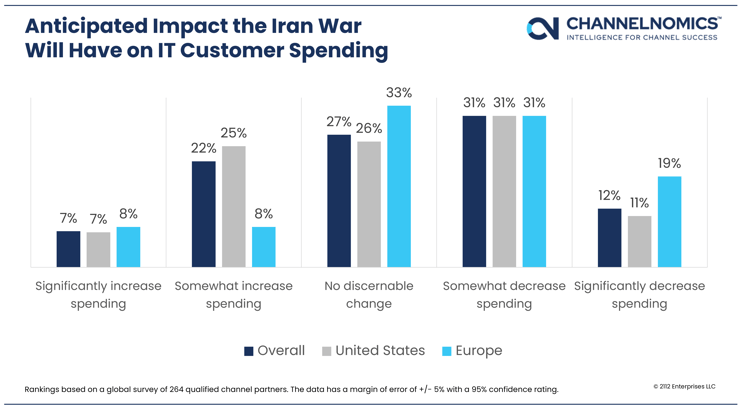
At the demand level, half of European partners and 42% of North American partners expect IT spending to decline through the end of the year. Only one-third of North American partners and 16% of European partners anticipate increased customer spending, reflecting expectations of a constrained demand environment shaped by inflation and economic uncertainty.
Financial performance data reveals a more complex picture, with outcomes diverging based on partner focus and exposure to cost pressures.
The strongest area of upside is security. Overall, 24% of partners report margin improvement driven by high-value security services, with the effect more pronounced in Europe (33%) than in the United States (22%). Heightened geopolitical risk and ongoing concerns around cybersecurity are driving customers to prioritize security investments, creating opportunities for partners with the right capabilities.
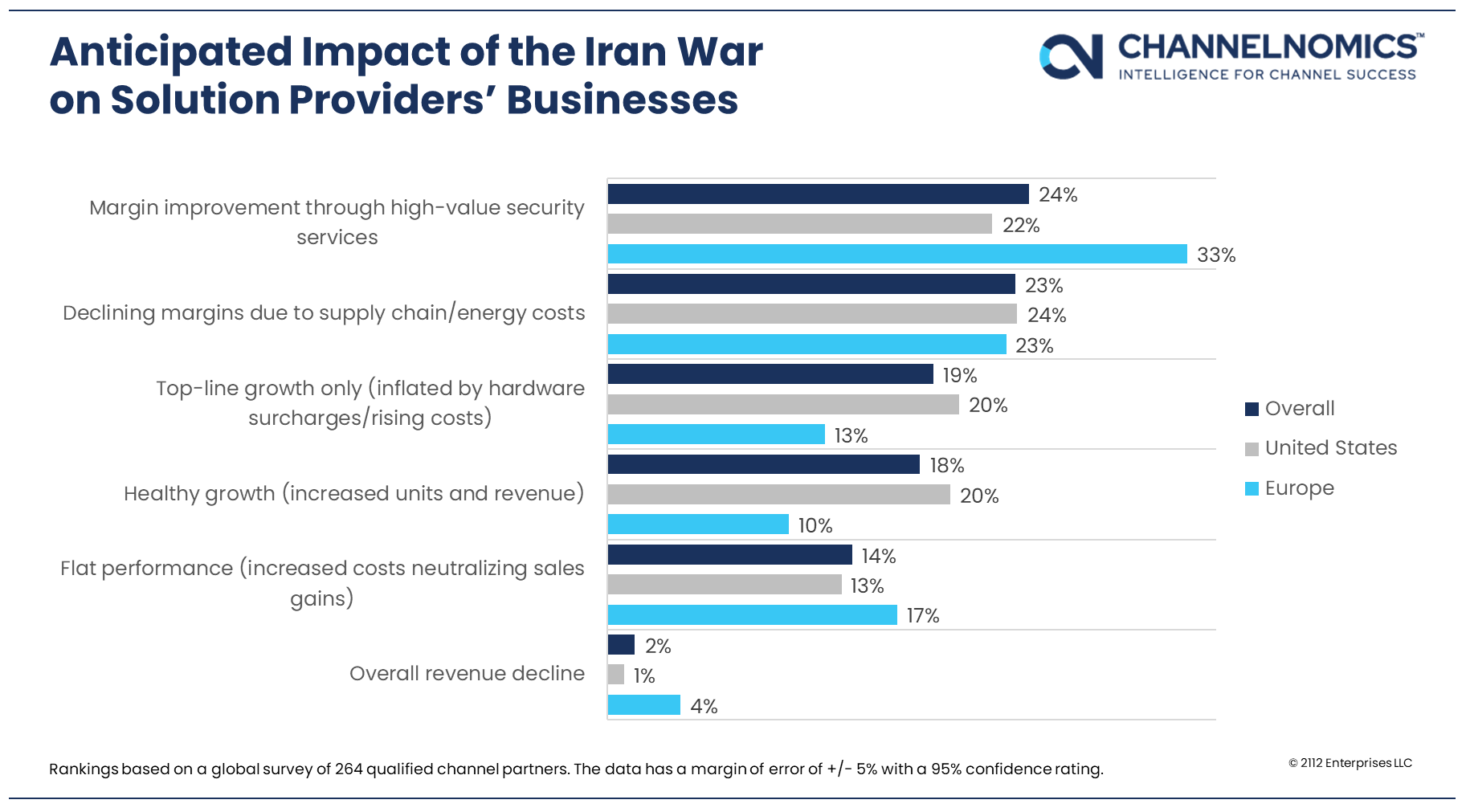
At the same time, nearly an equal share — 23% overall — report declining margins due to supply-chain disruptions and rising energy costs (24% in North America, 23% in Europe). The continued closure of the Strait of Hormuz and constrained shipping routes are directly contributing to these pressures, particularly as fuel costs and logistics expenses remain elevated.
Meanwhile, 19% of partners report top-line growth largely driven by inflation rather than demand. In these cases, revenue gains are tied to hardware surcharges and rising input costs being passed through to customers. This dynamic is more evident in North America (20%) than in Europe (13%), suggesting regional differences in pricing flexibility or customer tolerance.
Sustainable, demand-driven growth is more limited. Only 18% of partners report healthy growth based on increased units and revenue, with a notable gap between North America (20%) and Europe (10%). Europe’s heavier exposure to energy constraints and economic slowdown appears to be suppressing true growth opportunities.
For a segment of the market, rising costs are effectively canceling out gains. Among the partners surveyed, 14% report flat performance, with increased expenses neutralizing sales growth. This condition is more prevalent in Europe (17%) than in North America (13%), again reflecting the region’s higher cost burden.
Outright revenue decline remains limited but is more visible in Europe, where 4% of partners report declining revenue compared to 1% in the United States. Overall, just 2% of partners report contraction, but the figure suggests early signs of stress in the most affected markets.
These financial outcomes align with broader operational concerns. In North America, 35% of partners expect operating costs to rise as fuel prices drive increases across transportation, food, and other consumables. In Europe, 38% anticipate accelerating inflation, with fuel shortages and gasoline prices reaching between $9 and $11 per gallon in some markets.
Recession fears are also building. About 35% of North American partners and 25% of European partners believe the conflict could push their regional economies into recession. Europe is already experiencing low growth, including in major economies such as Germany, while the United States remains more resilient but exposed to prolonged geopolitical and trade disruptions.
Supply-chain constraints continue to amplify pricing pressures. About 35% of North American partners and 17% of European partners expect price increases for products and services. The combination of an ongoing memory chip shortage and reliance on Middle East oil and helium for manufacturing continues to disrupt production. Even with a ceasefire in place, the blockade and mined shipping lanes in the Persian Gulf are preventing a return to normal trade flows.
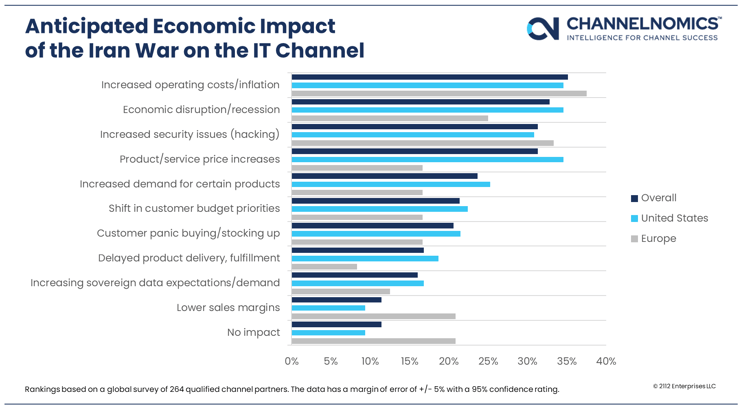
Security, again, remains a relative bright spot - at least from a sales perspective. One-third of partners in both regions expect increased customer investment in cybersecurity due to heightened concerns about state-sponsored attacks. While Iran’s cyber activity has been sporadic rather than sustained, the perceived risk is enough to shift customer priorities.
That shift is already evident. About one in five partners report that customers are reprioritizing spending. Some of this reflects the need to absorb rising costs, while the remainder is driven by a strategic pivot toward security and core operational resilience.
Taken together, the data points to a fragmented channel environment shaped by prolonged uncertainty. The extended disruption of global shipping routes — particularly through the Strait of Hormuz — is reinforcing inflationary pressures and limiting visibility into recovery timelines. As a result, partner performance is diverging. Those aligned with high-value services such as security are finding opportunities for margin expansion, while others — especially those dependent on hardware or exposed to logistics volatility — are experiencing margin compression or stagnation.
The net effect is not a uniform downturn, but an uneven market where profitability increasingly depends on portfolio mix, cost control, and the ability to adapt to shifting customer priorities amid prolonged geopolitical instability.




